DreamerV2
Paper Link: ICLR 2021 Conference or arXiv.
DreamerV2 constitutes the first agent that achieves human-level performance on the Atari benchmark of 55 tasks by learning behaviors inside a separately trained world model.
This table lists some general features about DreamerV2:
Features of DreamerV2 |
Values |
Description |
|---|---|---|
On-policy |
❌ |
The evaluate policy is the same as the target policy. |
Off-policy |
✅ |
The evaluate policy is different from the target policy. |
Model-free |
❌ |
No need to prepare an environment dynamics model. |
Model-based |
✅ |
Need an environment model to train the policy. |
Discrete Action |
✅ |
Focus on discrete action space mainly. |
Continuous Action |
✅ |
Focus on continuous action space mainly. |
World Model
Introduction
Compared to model-free reinforcement learning, to successfully operate in unknown environments, reinforcement learning agents need to learn about their real environments over time. World models are an explicit way to represent an agent’s knowledge about its environment. The Dreamer series employs a latent dynamics model —a design also adopted by several other world models—which constructs a mapping from high-dimensional real-world environmental information to a low-dimensional latent space.
By predicting compact latent representations rather than high-dimensional observations, the world model not only reduce accumulating errors but also enables the construction of parallelized environments, thereby improving both computational and sample efficiency.
Despite the compelling characteristics of world models, as of 2020, their accuracy remains insufficient to compete with state-of-the-art model-free algorithms. However, DreamerV2 marked a significant breakthrough: DreamerV2 is the first agent that learns purely within a world model to achieve human-level Atari performance, demonstrating the high accuracy of its learned world model.
Compared with DreamerV1, DreamerV2 introduces several major improvements, among which two key advancements are highlighted here:
Categorical latents — DreamerV2 replaces the Gaussian latent variables used in DreamerV1 with categorical latent variables optimized through straight-through gradients, leading to more expressive and stable latent dynamics modeling.
KL balancing — Instead of employing the “free nats” technique, DreamerV2 applies KL balancing by separately scaling the prior cross-entropy and the posterior entropy within the KL divergence term, thereby encouraging a more accurate temporal prior and reducing posterior collapse.
Dreamer Model Framework
Dreamer world model consists of an image encoder, a Recurrent State-Space Model(RSSM) to learn the dynamics, and predictors for the image, reward, and discount factor:
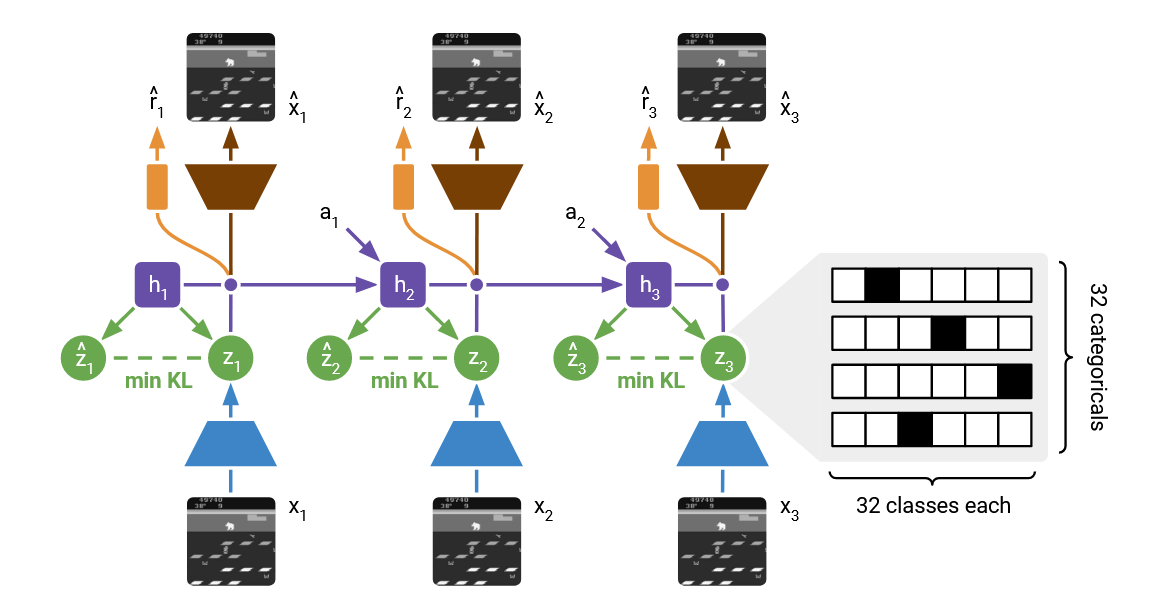
The core component of the DreamerV2 world model is the Recurrent State-Space Model (RSSM), which can be regarded as a fusion of a recurrent neural network variant (GRU) and a variational autoencoder (VAE). The world model can thus be interpreted as a sequential VAE.
So, the loss function of the world model corresponds to the Evidence Lower Bound (ELBO), or equivalently, the variational free energy, of a Hidden Markov Model (HMM) that is conditioned on the sequence of actions taken by the agent:
Behavior Learning
The world model remains fixed during the behavioral learning process and serves to generate auxiliary training trajectories:
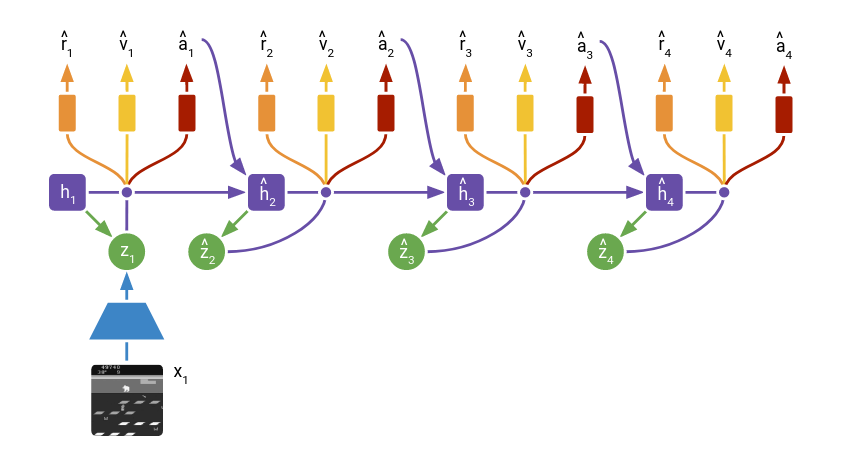
Therefore, classical model-free reinforcement learning algorithms (the original paper employs an Actor-Critic approach) can leverage trajectories generated by the world model to facilitate policy learning.
Run DreamerV2 in XuanCe
Before running DreamerV2 in XuanCe, you need to prepare a conda environment and install xuance following
the installation steps.
Run Build-in Demos
After completing the installation, you can open a Python console and run DreamerV2 directly using the following commands:
import xuance
runner = xuance.get_runner(algo='DreamerV2',
                           env='classic_control',  # Choices: classic_control, atari.
                           env_id='CartPole-v1',  # Choices: CartPole-v1, Pendulum-v1, ALE/Pong-v5.
                           )
runner.run()  # Or runner.benchmark()
Run With Self-defined Configs
If you want to run DreamerV2 with different configurations, you can build a new .yaml file, e.g. my_config.yaml.
Then, run the DreamerV2 by the following code block:
import xuance
runner = xuance.get_runner(algo='DreamerV2',
                           env='classic_control',  # Choices: classic_control, atari.
                           env_id='CartPole-v1',  # Choices: CartPole-v1, Pendulum-v1, ALE/Pong-v5.
                           config_path="my_config.yaml",  # The path of my_config.yaml file should be correct.
                           )
runner.run()  # Or runner.benchmark()
To learn more about the configurations, please visit the tutorial of configs.
Run With Custom Environment
If you would like to run XuanCe’s DreamerV2 in your own environment that was not included in XuanCe,
you need to define the new environment following the steps in
New Environment Tutorial.
Then, prepapre the configuration file
dreamerv2_myenv.yaml.
After that, you can run DreamerV2 in your own environment with the following code:
import argparse
from xuance.common import load_yaml
from xuance.environment import REGISTRY_ENV
from xuance.environment import make_envs
from xuance.torch.agents import DreamerV2Agent

configs_dict = load_yaml(file_dir="dreamerv2_myenv.yaml")
configs = argparse.Namespace(**configs_dict)
REGISTRY_ENV[configs.env_name] = MyNewEnv

envs = make_envs(configs)  # Make parallel environments.
Agent = DreamerV2Agent(config=configs, envs=envs)  # Create a dreamerv2 agent from XuanCe.
Agent.train(configs.running_steps // configs.parallels)  # Train the model for numerous steps.
Agent.save_model("final_train_model.pth")  # Save the model to model_dir.
Agent.finish()  # Finish the training.
Citation
@inproceedings{
hafner2021mastering,
title={Mastering Atari with Discrete World Models},
author={Danijar Hafner and Timothy P Lillicrap and Mohammad Norouzi and Jimmy Ba},
booktitle={International Conference on Learning Representations},
year={2021},
url={https://openreview.net/forum?id=0oabwyZbOu}
}
@article{hafner2020mastering,
  title={Mastering atari with discrete world models},
  author={Hafner, Danijar and Lillicrap, Timothy and Norouzi, Mohammad and Ba, Jimmy},
  journal={arXiv preprint arXiv:2010.02193},
  year={2020}
}